

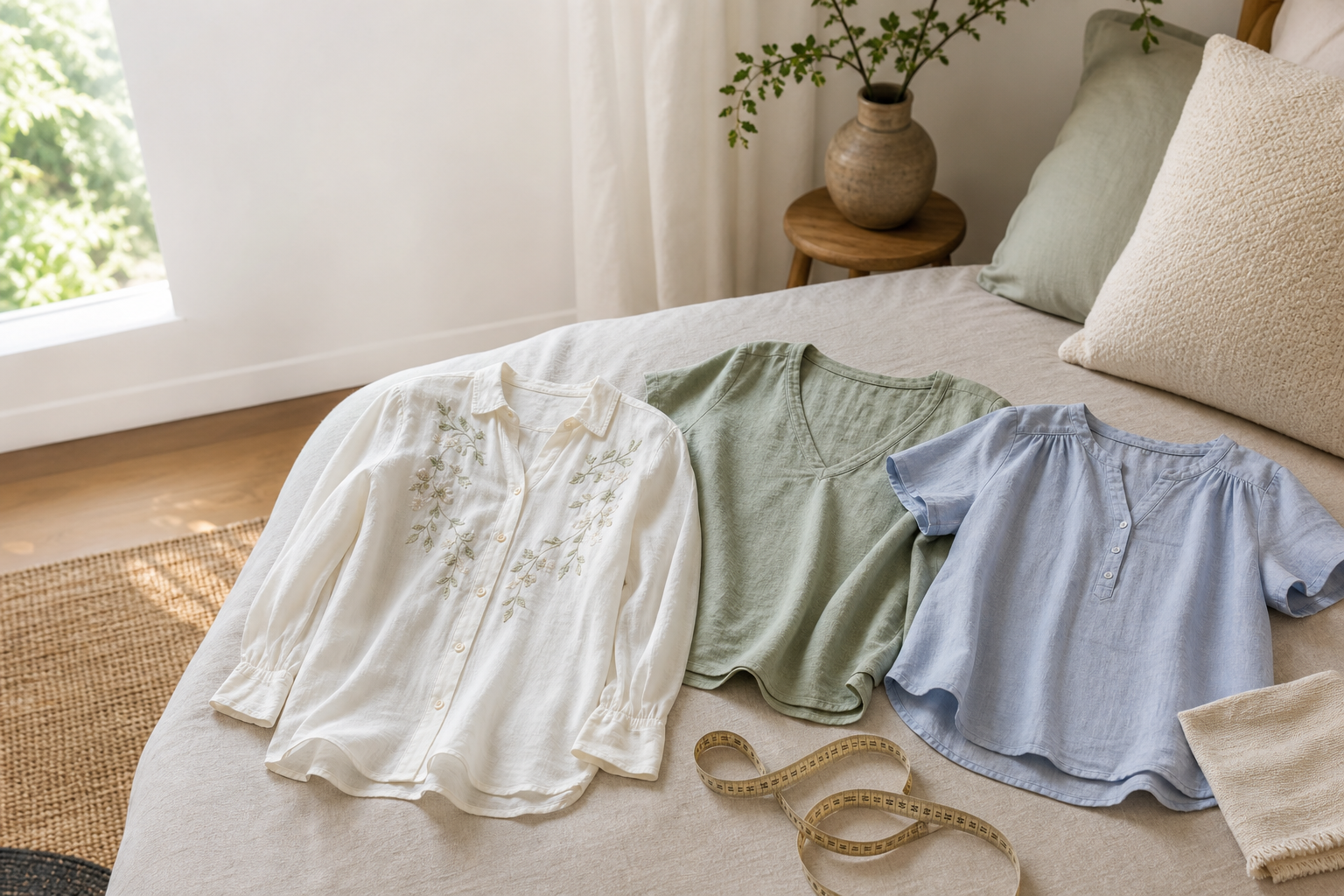
The short answer: a summer blouse should let you sit, reach and raise your arms without pulling at the buttons, neckline or upper back. The most reliable way to choose a size online is to measure a blouse you already enjoy wearing, compare those garment measurements with the current product chart, and preserve the amount of room—or “ease”—that feels right to you. Your body measurements are the starting point, but garment shape, fabric behaviour and your preferred silhouette complete the decision.
This guide explains a repeatable at-home method. It does not assume that one size label fits the same way across products, and it avoids guessing about fibre content: always check the live product details and the care label attached to the garment you receive.
Summer blouse fit at a glance
| Check | A comfortable result | Possible warning sign |
|---|---|---|
| Shoulders | Seam or intended drop sits consistently on both sides | Neckline shifts or upper back feels restricted |
| Bust and buttons | Fabric falls smoothly while standing and sitting | Button placket gaps or horizontal pull lines appear |
| Arm movement | You can reach forward and raise your arms comfortably | Hem rides sharply or armhole pinches |
| Length | Stays where you want when tucked, half-tucked or untucked | Needs constant adjustment during normal movement |
| Care plan | Instructions suit your routine before you remove tags | Required cleaning or drying method is impractical for you |
Start with a blouse you already like
Body measurements can help you locate a general size, but a favourite garment reveals how much room you actually prefer. Choose a blouse with a similar intended shape: compare a relaxed top with another relaxed top, not with a fitted stretch tee. Button or zip it as it would be worn, smooth it on a flat surface without stretching, and use a flexible tape.
- Chest width: measure straight across from underarm to underarm. Double this flat measurement only if the product chart uses full circumference.
- Shoulder width: measure across the back between the relevant shoulder seams. For dropped shoulders, note where the seams intentionally sit instead of forcing a conventional shoulder point.
- Garment length: measure from the highest shoulder point near the neckline to the hem.
- Sleeve and upper arm: follow the sleeve from its seam to the edge, then measure the sleeve opening or upper-arm width if the listing provides it.
Write “flat” or “circumference” beside every number. Mixing the two is a common source of ordering errors. Also confirm the unit: 20 inches is not 20 centimetres. A soft tape can shift, so measure twice and use the same starting and ending points each time.
Understand ease instead of chasing a size label
Ease is the difference between a body measurement and the garment’s measurement at the same area. Some ease permits movement; additional ease creates a relaxed or oversized look. There is no single correct number for every blouse because drape, closure, stretch and design intent vary. A woven button blouse that opens at the front may need a different comfort margin than a knit pull-on top.
Use the product description to understand the intended silhouette, then compare actual garment measurements when available. If you are between sizes, focus on the least flexible areas—often the shoulders, bust or upper arm—and on the look you want. Sizing up may add room but can also change neckline position, sleeve length and overall proportion.
Try a five-movement fit check
Do not judge a blouse only while standing still in front of a mirror. Keep the tags attached and perform ordinary movements over a clean base layer:
- Sit normally and check whether a button front remains smooth.
- Reach both arms forward as if driving or typing.
- Raise each arm overhead and notice how far the hem moves.
- Cross your arms gently to test the upper back.
- Turn side to side and confirm the neckline stays where intended.
A good fit does not require the garment to look identical in every pose. The aim is comfortable movement without persistent pulling, pinching or exposure. If a placket gaps only when seated, that still matters—seated time is part of real wear.
Compare two current Cmfrt Blouse shapes
The Dandelion Patch Button Summer Blouse is a useful starting point for shoppers considering a decorative button-front style. Because closures and placement affect fit, review its current photos, variants and size information before ordering. Check the bust while both standing and sitting, and make sure the embroidery or patch placement falls where you expect on your frame.
The Short Sleeve V Neck Loose Casual T Shirt provides a different silhouette: a loose short-sleeve V-neck top. Compare its neckline depth, sleeve opening and overall length with a similar top you own. “Loose” describes design intent, not a universal fit guarantee, so the measurement comparison still matters.
These links are examples from the active catalog, not claims that one shape or material suits every climate or body. Product details and availability can change; the live product page is the authoritative place to check current options.
Choose for hot-weather comfort without guessing the fabric
For summer wear, look beyond a fibre name. Fabric weight, weave or knit structure, lining, colour, cut and airflow all influence comfort. A roomy silhouette can improve air movement, while a fitted layer may work better under a jacket. Examine close-up photos, read the listed composition when provided, and check whether the garment is lined or sheer.
If sun protection is important, clothing coverage is only one part of the plan. The Government of Canada’s sun-safety guidance recommends seeking shade and using protective clothing, a wide-brimmed hat, sunglasses and sunscreen. A lightweight fashion blouse should not be assumed to carry a tested ultraviolet-protection rating unless the product specifically states one.
Read the care label before the first wash
Care advice must follow the garment, not a generic blog rule. The Government of Canada’s consumer information on clothing and textiles explains that labels provide fibre-content information that helps shoppers compare textiles. The U.S. Federal Trade Commission’s Care Labeling guidance describes the role of care instructions for garments sold in the United States.
Before washing, photograph the label so the instructions remain available later. Close buttons or fasteners if directed, separate colours appropriately, and treat decorative details gently. Use the specified wash temperature and drying method. Do not assume every blouse can be machine dried, ironed at high heat or treated with bleach. If the care wording is unclear, choose the gentler option and seek product-specific guidance before proceeding.
A practical pre-purchase checklist
- Compare the exact product chart with a similar garment you own.
- Confirm whether measurements are flat or around the body.
- Check inches versus centimetres and remeasure once.
- Look closely at neckline, shoulder, sleeve opening and length.
- Read fibre, lining and care information on the current listing.
- Review the store’s current shipping and return policies before ordering.
- Keep tags attached until you have completed the movement test.
Frequently asked questions
Should I size up in a summer blouse?
Not automatically. Compare the garment measurements and intended silhouette with a blouse you own. Size up only when the added room solves your fit preference without creating unwanted changes at the neckline, shoulders or length.
How do I check whether a button blouse is too tight?
Fasten it and check while standing, sitting, reaching forward and crossing your arms. Persistent gaps at the placket, horizontal tension lines or restricted movement suggest that a different size or shape may fit better.
Are body measurements enough for online sizing?
They are useful, but garment measurements add essential context. Two blouses designed for the same body measurement can have different amounts of ease and different shoulder, sleeve or length proportions.
Will a blouse shrink in the wash?
Shrinkage depends on materials, construction and care. Do not predict it from appearance alone. Follow the attached care label and avoid hotter washing or drying than the instructions permit.
What is the easiest blouse measurement to compare?
Flat underarm-to-underarm width is often a useful first check, but it should be combined with shoulder, length and upper-arm measurements when those areas affect your comfort.
The takeaway
A comfortable summer blouse begins with evidence: a favourite garment, consistent measurements, the current product chart and a realistic movement test. Focus on ease and proportion rather than the letter on the label. Then follow the garment’s own care instructions so the fit and finish you chose have the best chance of lasting.